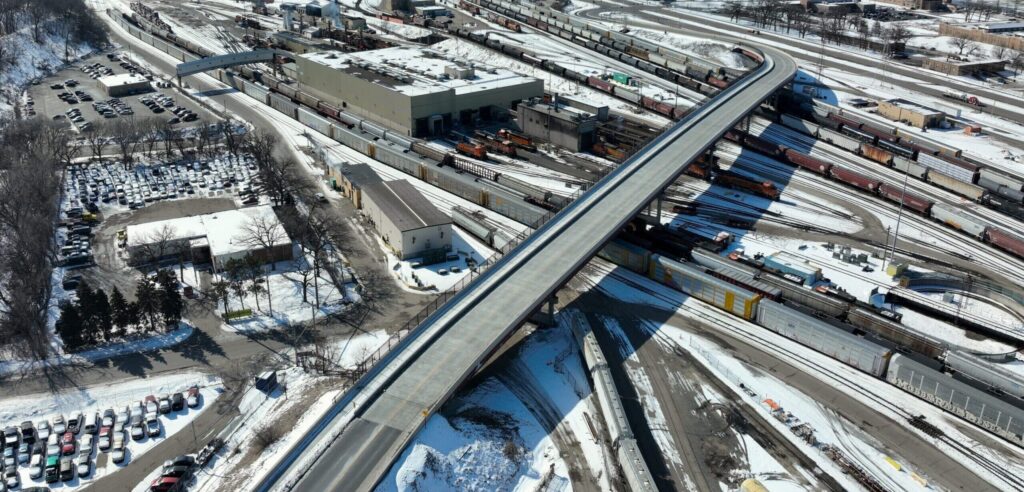
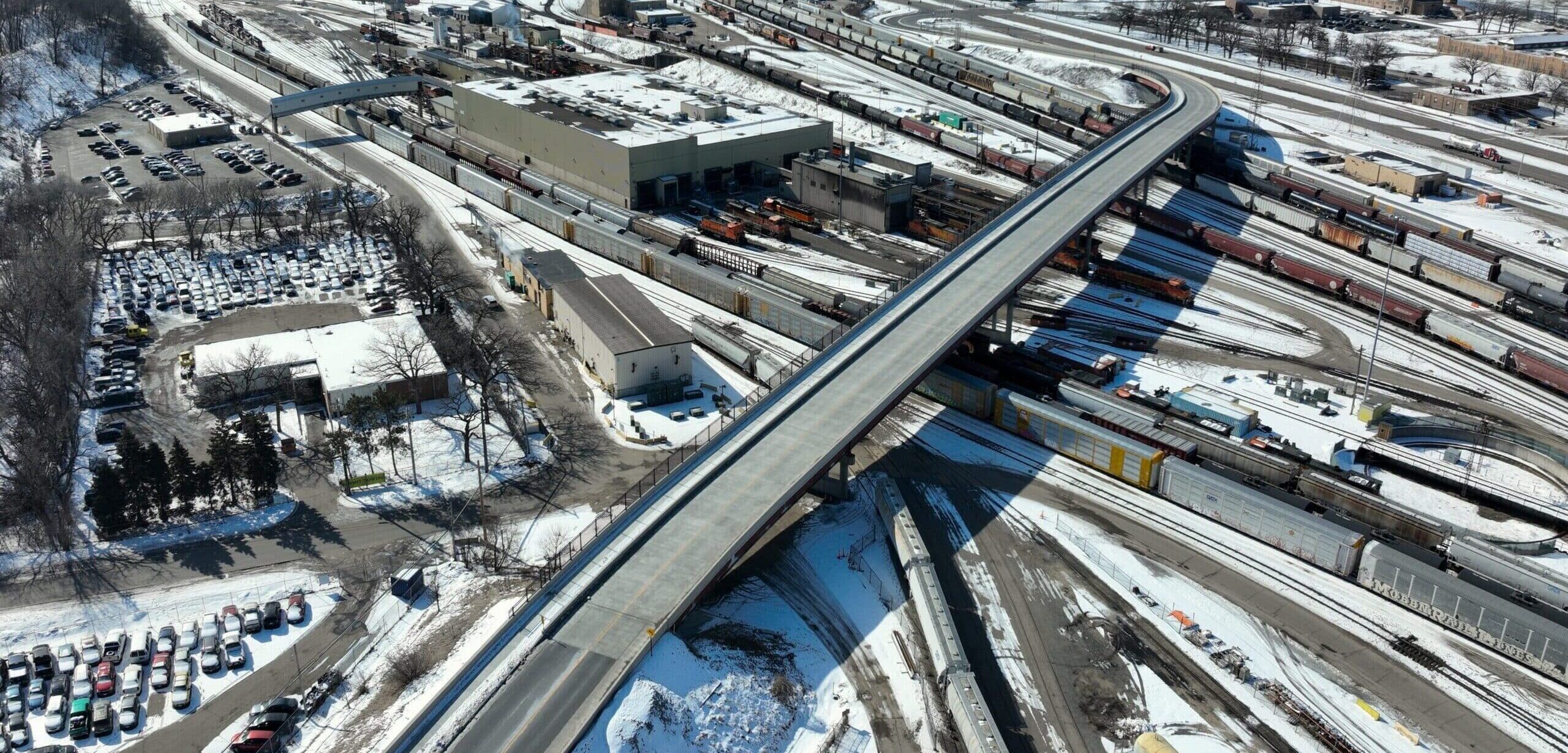
On paper, this started as a straight-forward trail project. The Anoka County Highway Department wanted to convert a 5-foot sidewalk on their 44th Avenue Bridge into a 12-foot multi-use trail. The bridge, the longest on the Anoka County system at 1,164’-6”, spans over the BNSF Railway’s Northtown Yard, one of the most critical east-west rail corridors in the country, which is also a hump yard with 29-tracks and a diesel mechanic shop underneath it.
It soon became apparent this project was anything but simple. Because the original bridge deck was built with stay-in-place forms, the true condition of the concrete deck was not known when the project was originally scoped. The original plan was to make simple modifications to shoulder widths and existing concrete barriers to widen the trail on the existing bridge deck without widening the overall width (and dead load). But early in the design process, TKDA’s team discovered the bridge deck over the rail yard was severely deteriorated. Addressing the new trail without replacing the entire bridge deck wasn’t an option, so what followed was a shift in project scope and scale. What was originally envisioned as developing a modest multi-use trail evolved into a complex bridge rehabilitation that required a great deal of trust, precision, and collaboration between Anoka County, BNSF Railway, and TKDA.
“This project shows what can happen when stakeholders stay focused on shared outcomes,” said Joe MacPherson, County Engineer. “Our goal at the County was to improve safety and maintain connectivity for our community; but doing that over an active rail yard meant we had to work hand in hand with BNSF every step of the way.”
Building Over an Active Rail Yard from the Top Down
Unlike typical bridge rehabilitation projects, the 44th Avenue Bridge had to be reconstructed from the top down. The active rail yard below eliminated the possibility of setting up falsework in the yard or allowing demolition debris to fall beneath the bridge. Every construction activity had to prioritize rail operations that could not be disrupted at any time. These constraints brought innovative solutions, including the use of suspended falsework under the bridge for the bridge deck removal and construction sequencing designed around rail safety protocols.
Disruption to the Northtown Yard would have resulted in significant system-level impacts on BNSF’s national rail operations. The project necessitated continuous interagency coordination and structured communication protocols to ensure compliance with operational and safety requirements. Effective collaboration among Anoka County, BNSF, TKDA, and the construction contractor was critical to maintaining uninterrupted, safe, and reliable rail service throughout project execution.
Creating a True Multi-Modal Connection to Improve Communities and Industries
Prior to constructing this project, pedestrian and bicycle accommodations were fragmented and unsafe in areas. The sidewalk abruptly ended, forcing pedestrians and bicyclists into traffic or behind the guardrail. The rehabilitated bridge now supports vehicles, trucks, pedestrians, and bicyclists with continuous sidewalks.
Additionally, the bridge serves as a critical industrial corridor. Major employers in the area depend on this roadway as a truck route. By improving this single crossing for all modes, it shortens people’s travel times, reduces emissions, and improves efficiencies for residents and freight. Overall, by extending the bridge’s lifespan and improving safety for all users, the project’s outcome includes protecting local mobility and regional economic activity.
Prioritizing Partnership Through Each Project Phase
Delivering a public project over an active rail yard is more than just a technical challenge, it requires extensive collaboration and trust between all parties involved. Anoka County prioritized safety and connectivity for its residents and visitors, and BNSF required confidence that its infrastructure and workers would always be protected. Additionally, the contractor needed assurance that railroad access restrictions would not derail the construction schedule. The trust between these groups was built through continuous collaboration.
“This was truly a partnership,” said Jerry Auge, Assistant County Engineer. “Each side had non negotiables, but we worked together to develop a project that serves the public, and supports the economy, and maintained a vital connection for emergency services in the heart of the community.”
A Model for Future Infrastructure Projects
What began as a trail improvement ultimately became a huge investment in safety, mobility, and economic resilience. The 44th Avenue Bridge Rehabilitation demonstrates that when public agencies and private infrastructure partners collaborate early and often, they can deliver projects that do far more than fix what’s broken. They can connect communities, protect critical supply chains, and set a higher standard for how complex infrastructure gets done in Minnesota.