On June 24, 2024, flooding on the Blue Earth River carved a new path around the west end of the Rapidan Dam and destabilized the nearby bridge that carried County Road 9 traffic across the river. The bridge was ultimately deemed irreparably damaged and demolished, leaving local residents and farm-to-market traffic with an 11-mile detour.
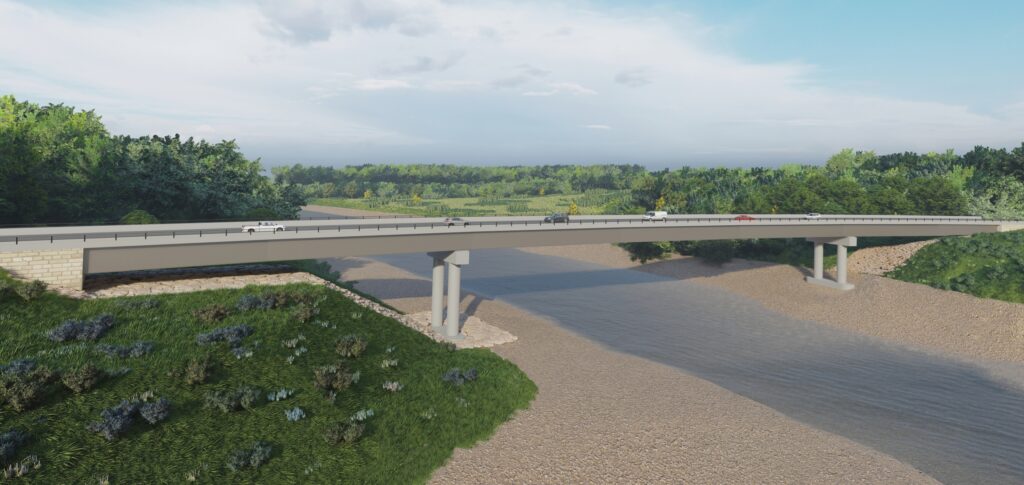
With the dam slated for removal in 2027, Blue Earth County turned to TKDA to design a replacement bridge in essentially the same location, one that will span the river after the dam is gone.
It was an unusual assignment: design a large bridge on an accelerated timeline not only for the river that exists today with the dam in place, but for the river that will evolve over the coming decades once the dam is removed.
Anticipating Answers to Changing Conditions
The Blue Earth River is expected to continue reshaping itself following the removal of the century-old dam. That meant TKDA’s engineers had to design for three versions of the Blue Earth River: today’s conditions, those immediately following dam removal, and a future river that cannot be precisely known. The design needed to account for anticipated erosion, lower river elevations, high-velocity flows, and the changing exposure of the bridge’s foundation.
The result is a three-span, 776-foot curved steel bridge with a 350-foot main span. Its tall piers are supported by pairs of eight-foot-diameter drilled shafts extending deep into the sandstone. The scale is significant, but the design philosophy was deliberately straightforward: avoid unnecessary complexity while creating a structure that can be analyzed, constructed, inspected, and maintained for many years to come.
“Sometimes the most innovative ideas aren’t groundbreaking or complicated,” said Matt Christensen, TKDA’s Surface Transportation Vice President. “A good innovative idea is often relatively straightforward and simple. It’s just different.”
At roughly 100 feet tall, the bridge must also contend with forces created by its own scale, including substantial wind exposure and lateral forces pushing it from side to side. Its weight and roadway profile concentrate up to 10 inches of seasonal thermal movement at the east abutment. At the west end, lateral loading posed an additional challenge. The tall, flexible piers and steel superstructure allow a slight rotation at the west end. Conventional design details would have struggled to resist this movement, generating substantial force.
“One of my mentors taught me early in my career that you need to work with environmental forces,” Matt said. “You have to accommodate them. You don’t want to fight them. With a more traditional detail, it was pretty clear we were fighting the bridge.”
Instead, TKDA engineers designed a custom solution that allows for a slight rotation of the bridge superstructure, releasing the environmental forces. A large buried concrete thrust block anchors the bridge, while additional details maintain alignment, control lateral movement and transfer forces from the bridge’s beams to the abutment. Together, the components provide a relatively simple solution to manage approximately 1.5 million pounds of force.